
Erie County Court Records After a Jail Arrest
The Erie County jail inmate records page explains the custody side: Jail ID, booking date, charge text, bail, court, disposition, arresting agency, and release date. Court records after jail arrest are different. They begin when the prosecutor and court create formal case filings, such as a complaint, indictment, information, journal entry, warrant, bond order, plea, dismissal, or sentencing entry. A roster line is useful for the starting point, but the court record is the official case trail.
Erie County uses multiple court paths after an arrest. Municipal cases can start in the Erie County Municipal Court search system or another municipal court named on the roster, while felony cases often move to Erie County Common Pleas through the Clerk of Courts Public Information Case System. Booking photos are a separate jail record topic covered on the Erie County jail mugshots page.
How to Find Court Records After an Erie County Arrest
Start with the jail roster only long enough to identify the court, book date, next court date, and charge wording. Then move to the court system named on the roster. Erie County Municipal Court provides a public search and online payment entry point at RecordSearch.aspx. The disclaimer says users can search by name, ticket, or case number and warns that online data can lag at least 24 hours and may lag longer. Verified information requires sending a request to the court or visiting during regular business hours.
- Open the current jail roster and record the person's name, court, charge text, disposition, bail, book date, and next court date.
- If the court is Erie County Municipal Court, search by name, ticket number, or case number through the municipal record search page.
- If the matter is felony-level, bound over, or listed in Erie County Common Pleas, use the Clerk Public Information Case System at clerkofcourts.eriecounty.oh.gov/eservices/home.page.2 or contact the Clerk Criminal Division.
- Open the case and compare charge names, counts, degree levels, court events, bond entries, and current status against the jail roster.
- For certified or verified copies, use the clerk or court office rather than treating a web result as the final record.
The municipal e-services screenshot is from the Erie County Municipal Court e-services destination.
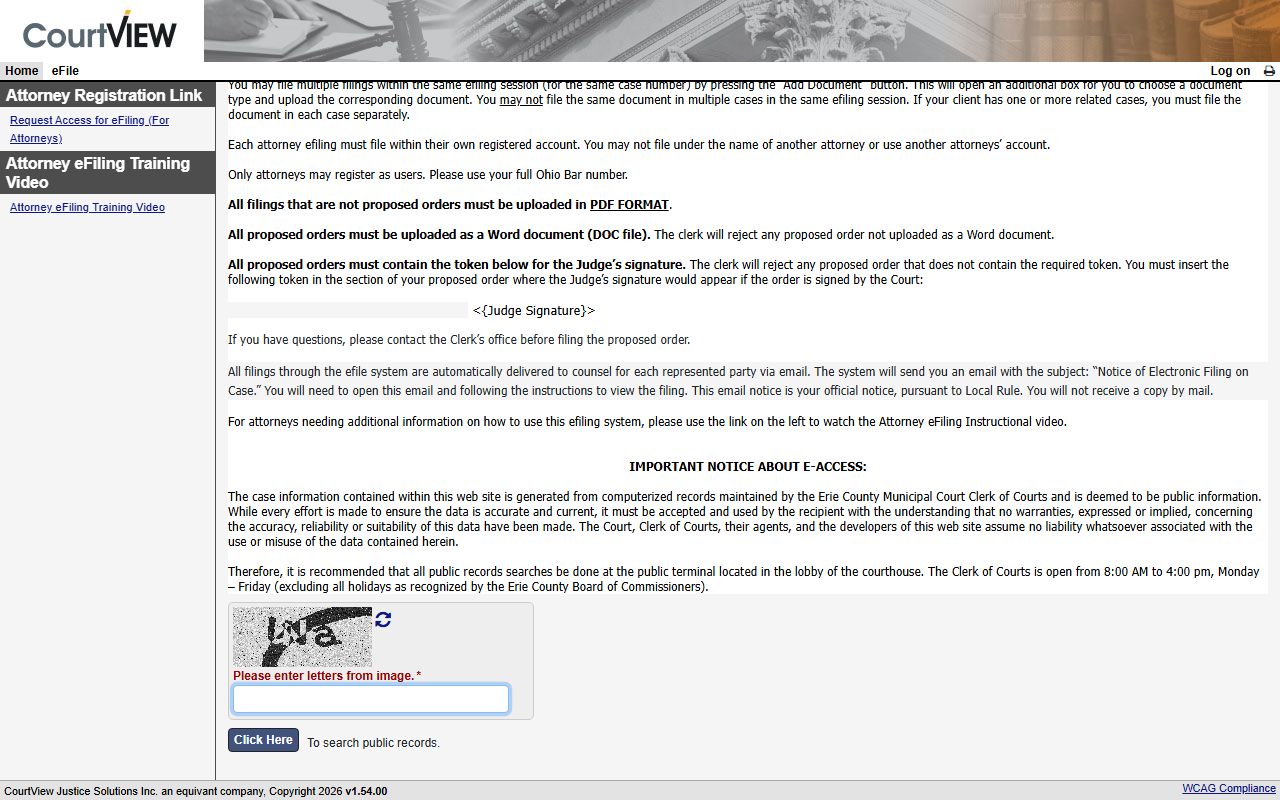
The municipal search path is useful for misdemeanor, traffic, and lower-court matters, while felony files require the Common Pleas and Clerk path when the case moves beyond the municipal stage.
Court Search Fields After a Jail Arrest
Erie County court search fields vary by system. The municipal research captured a disclaimer entry page rather than a fully text-readable search screen, but the county instructions identify the core search methods. The Clerk Public Information Case System required JavaScript or meta-refresh in the capture, so the fallback is the Clerk Legal Office and Criminal Division for verified felony records.
| System | Search Field | Use | Verification Note |
|---|---|---|---|
| Erie County Municipal Court | Name | Find a defendant or citation record when the roster points to municipal court. | Online data may lag; verified records require court request or visit. |
| Erie County Municipal Court | Ticket Number | Find traffic or citation matters. | Eligible citations may show a green Pay action. |
| Erie County Municipal Court | Case Number | Find a known municipal case directly. | Use exact case information when available. |
| Clerk Public Information Case System | Case lookup fields not text-readable in capture | Search Common Pleas and clerk-maintained public case information. | Call or visit the Clerk Legal Office for verified felony records. |
| Jail roster cross-check | Court, next court date, disposition | Identify which court path to search first. | Booking charge text is not the final court charge. |
Charging Documents After an Arrest
The Erie County Clerk of Courts explains that the clerk files, dockets, indexes, and preserves pleadings for felony criminal cases, civil cases, domestic relations, and miscellaneous cases. The Clerk Criminal Division says it retains felony case records, escape cases, extraditions, and expungements. The Prosecutor represents the State of Ohio and files the criminal case in court. That means the court record after a jail arrest is built from prosecutor and court filings, not only from the sheriff's booking entry.
| Document | Who Uses It | What It Does | Erie County Context |
|---|---|---|---|
| Complaint | Law enforcement or prosecutor | Starts a criminal accusation in a lower court. | Often appears near the beginning of a municipal or preliminary case path. |
| Information | Prosecutor | Files formal charges without using an indictment path where allowed. | Part of the prosecutor-filed case record when the felony path supports it. |
| Indictment | Grand jury and prosecutor | Charges felony counts after grand-jury action. | Common Pleas records should be checked for indictment-level felony charges. |
| Journal entry or order | Court | Records bond, hearings, warrants, dismissal, plea, sentencing, or other rulings. | Clerk-maintained records are the official source for verified entries. |
Charge Status in Court Records After an Arrest
Charge status can change after the booking stage. Roster examples include New Booking, Court Ordered, Sentenced, Bound Over, Time Served, and Case Dismissed. Those terms help explain current jail status, but a court docket may show more exact case activity: complaint filed, bound over, indictment filed, amended charge, dismissed count, plea, conviction, sentencing, or warrant. Always compare the court record to the roster, especially when the roster shows a municipal case that later moves to Common Pleas.
| Status | What It Means | Why It Matters |
|---|---|---|
| New Booking | The jail has recently booked the person. | Filed court charges may not be fully visible yet. |
| Bound Over | A lower-court matter is moving to Common Pleas felony handling. | Search the Clerk system after checking municipal records. |
| Case Dismissed | A listed charge or case was dismissed in that court context. | Check for other counts, refiling, holds, or related cases. |
| Sentenced | The person has a sentence or custody sanction. | Future transfer to ODRC may shift lookup from county to state. |
| Probation or parole violation | Custody is tied to supervision status. | A hold can continue even if a new charge has low or no bond. |
| Warrant or bench warrant | Court action authorized arrest or detention. | The issuing court should be checked for current warrant status. |
Bond, Release, and Court Records After Jail Arrest
Bond on an Erie County arrest should be read from both the jail and court sides. The roster may show Total Bail for each line, but the court order controls the release terms. The Erie County Jail FAQ says non-surety jail bonds must be posted by money order in the correct amount, payable to the court of jurisdiction, with purchaser or remitter information included. Cash, checks, and credit cards are not accepted for bond at the jail. Approved surety bonds are accepted at the jail any time, except for Vermilion Municipal Court bonds, which are handled through that court or Vermilion Police Department depending on the time.
| Bond Type | How It Works in Erie County Sources |
|---|---|
| Money-order bond | Required for non-surety bond posted at the jail, payable to the court of jurisdiction. |
| Surety bond | Posted by an approved bond agent and generally accepted at the jail any time, except Vermilion Municipal Court cases. |
| PR or recognizance | May be ordered by a court, but local jail FAQ procedures were not published. |
| No-bond or hold | Other-agency, parole, federal, ICE, CRC, or court holds may prevent release. |
Warrants That Lead to Court Records and Arrest
Erie County Sheriff's navigation referenced a Warrant List, but the researched target returned a 404 at the Glyph warrants URL. That should be treated as a broken or changed endpoint, not as proof no warrants exist. The sheriff's 2025 annual report states sworn personnel served 841 arrest warrants, and the Clerk of Courts page says the clerk issues service forms including warrants to arrest. The jail roster also showed warrant-related entries such as bench warrant, bond revoke, and failure-to-comply language.
For warrant-related court records, use the issuing court or clerk as the verified source. The Glyph Reports portal can help with incident reports by report number, party name, and date range or report type, but it is not a clean public warrant database. For custody questions, call the Erie County Jail Division. For court status, call the court or Clerk Criminal Division. Do not rely on an online roster entry alone to resolve a warrant.
Prosecutor Role in Court Records After Arrest
Ohio counties use a Prosecuting Attorney rather than a district attorney title. Erie County Prosecuting Attorney Kevin J. Baxter's office is described on the official Erie County Prosecutor page as responsible for investigation and prosecution of criminal activity in Erie County, including property crimes and serious violent crimes, with victim and witness services. The Prosecutor Criminal Division represents the State of Ohio in prosecuting adult felony crimes and juvenile offenses. After police or sheriff booking, prosecutor review is the step that can convert an arrest allegation into a filed charge, amended count, indictment, plea negotiation, or dismissal.
The prosecutor staff page names Kevin J. Baxter as Prosecuting Attorney and Paulette J. Lilly as Chief Assistant for the Criminal Division. The court record is where prosecutor action becomes visible through filings and docket entries. That is why the roster's Charges column should be read as a starting point rather than a final charging document.
Charges vs. Convictions
A person can be arrested, booked, charged, and still not be convicted. Court records after an arrest may show accusations, bond entries, hearings, dismissed counts, amended counts, pleas, verdicts, and sentences. A conviction generally requires a guilty plea, no-contest finding where applicable, or trial verdict followed by court judgment. Treat any charge record as an accusation unless the docket shows a conviction or sentencing entry.
| Charge | Conviction | |
|---|---|---|
| Stage | Accusation filed or listed after arrest. | Final finding or plea accepted by the court. |
| Source | Roster, complaint, information, indictment, or docket entry. | Judgment entry, sentencing entry, or final docket disposition. |
| Can Change | Yes, charges may be amended, reduced, added, or dismissed. | Changes require later court action, appeal, sealing, expungement, or correction. |
| Use Caution | Not proof of guilt. | Still verify identity, case number, and final status with the clerk. |
Sealed vs. Expunged Court Records After Arrest
Ohio Revised Code 2953.32 controls sealing or expungement of eligible conviction and bail-forfeiture records, with exceptions, waiting periods, hearing notice, and fee provisions. The Erie County Clerk Criminal Division lists $100 for an application to seal a conviction under ORC 2953.32, $100 for a motion to expunge a conviction, $0 for an application to seal a non-conviction criminal record, and $0 for a motion to expunge a non-conviction criminal record.
| Sealed | Expunged | |
|---|---|---|
| Public visibility | Removed from ordinary public access when the court grants relief. | Treated more like destruction or deletion where Ohio law allows it. |
| Eligibility | Depends on offense, disposition, waiting period, and statutory exceptions. | Depends on the specific expungement statute and case type. |
| Records affected | Official court and related criminal records as ordered. | Official records covered by the expungement order. |
| Online limits | May not automatically remove every copied third-party reference. | Does not prove that all external copies disappeared. |
Copy Fees and Verified Court Records
The Clerk Criminal Division page at eriecounty.oh.gov/CriminalDivision.aspx describes felony criminal records and copy fees. The research found all copies from the Clerk's Office listed at $0.25 and all criminal certified copies listed at $2.00. Certified copies needed for school entrance have no fee when proper documentation accompanies the request. The Clerk Legal Office is at 323 Columbus Avenue, Sandusky, OH 44870, phone (419) 627-7706, with hours Monday through Friday, 8:00AM to 4:00PM.
The Clerk Criminal Division fee screenshot comes from the official criminal division source.
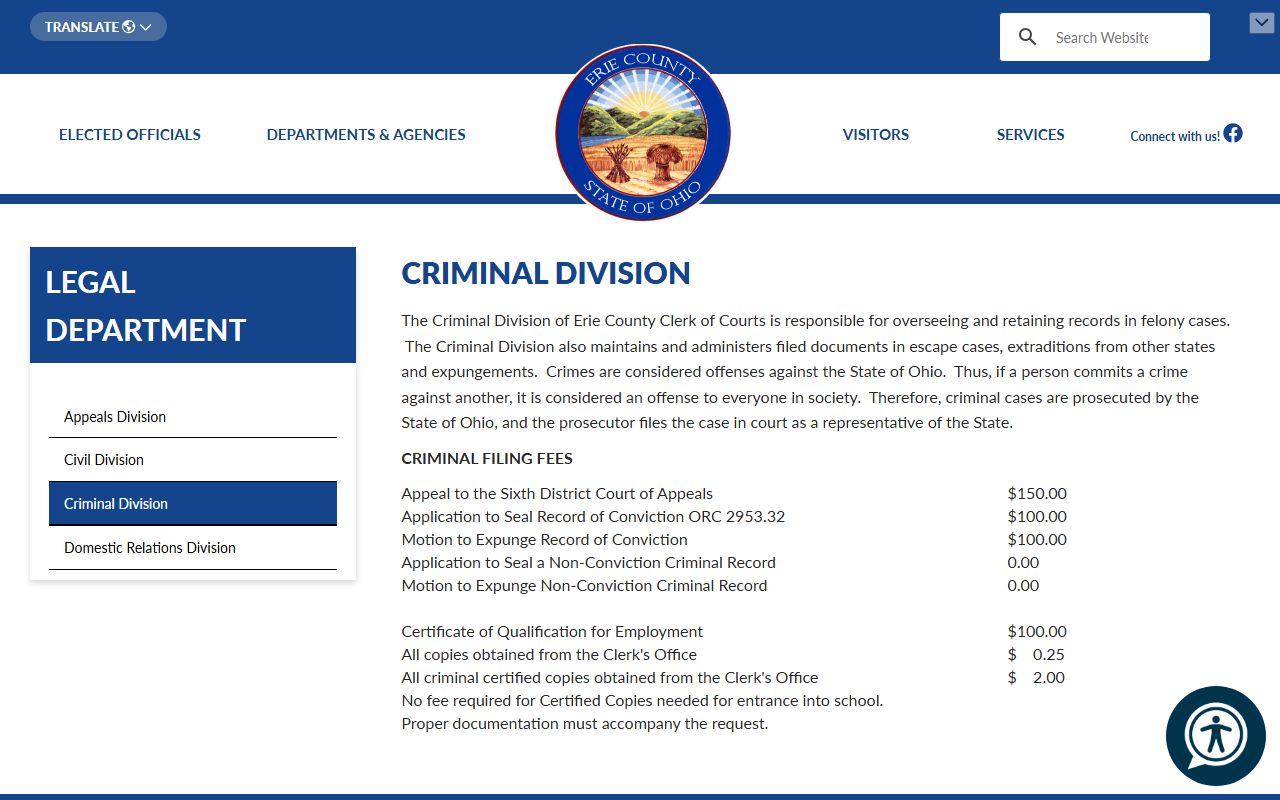
Use certified copies when the record must be presented to another court, licensing body, school, agency, or attorney. Use web lookups for orientation, not as a substitute for a verified clerk record.
Use restriction: This privately run resource is not a consumer reporting agency, and court or jail information may not be used for FCRA-covered screening.